Before you spend money on a bore, you want to know three things: is there water under your land, how deep is it, and will it give enough for what you need. This guide explains how to find bore water on your property, what you can check yourself for free, and how a driller decides exactly where the bore goes.
Is there bore water under your property?
Bore water is groundwater, held underground in an aquifer and brought to the surface through a drilled bore. Our guide to what bore water is covers where it comes from. Whether a bore will work on your land comes down to the aquifer under it, how deep the water sits and how much water the bore can sustain once it is pumped.
You can’t tell any of that by looking at the paddock. Depth to the water table varies enormously across NSW, sometimes between neighbouring properties. So the search starts with records, not with a spade.
Check the bore records near you
The best free evidence is the bores already drilled around you. The Bureau of Meteorology’s Australian Groundwater Explorer maps around 900,000 bore locations across Australia, with bore logs and, for some bores, water levels and salinity. A bore log shows how deep the bore was drilled, what ground it went through and how it was built.
Treat the map as a starting point. Not every bore has water level data, and the records are only as current as the agency that supplied them.
Two other sources are worth chasing:
- Your own paperwork. If there is already a bore on the property, find its bore record. A completed bore record shows the depth, the strata, the casing and screen setup and the yield at completion.
- Your neighbours. Ask what depth they hit water, how much their bore gives and what the water is like. It is a guide rather than a guarantee, because the ground can change over a short distance.
What aquifer mapping and the local geology tell you
A driller reads the same records, plus aquifer mapping and the local geology, to work out where the water is likely to be and at what depth. That is how we site every bore: on the geology first, using aquifer mapping, the depth of the water table and the records from surrounding bores. It gives you an expected depth range before a rig arrives.
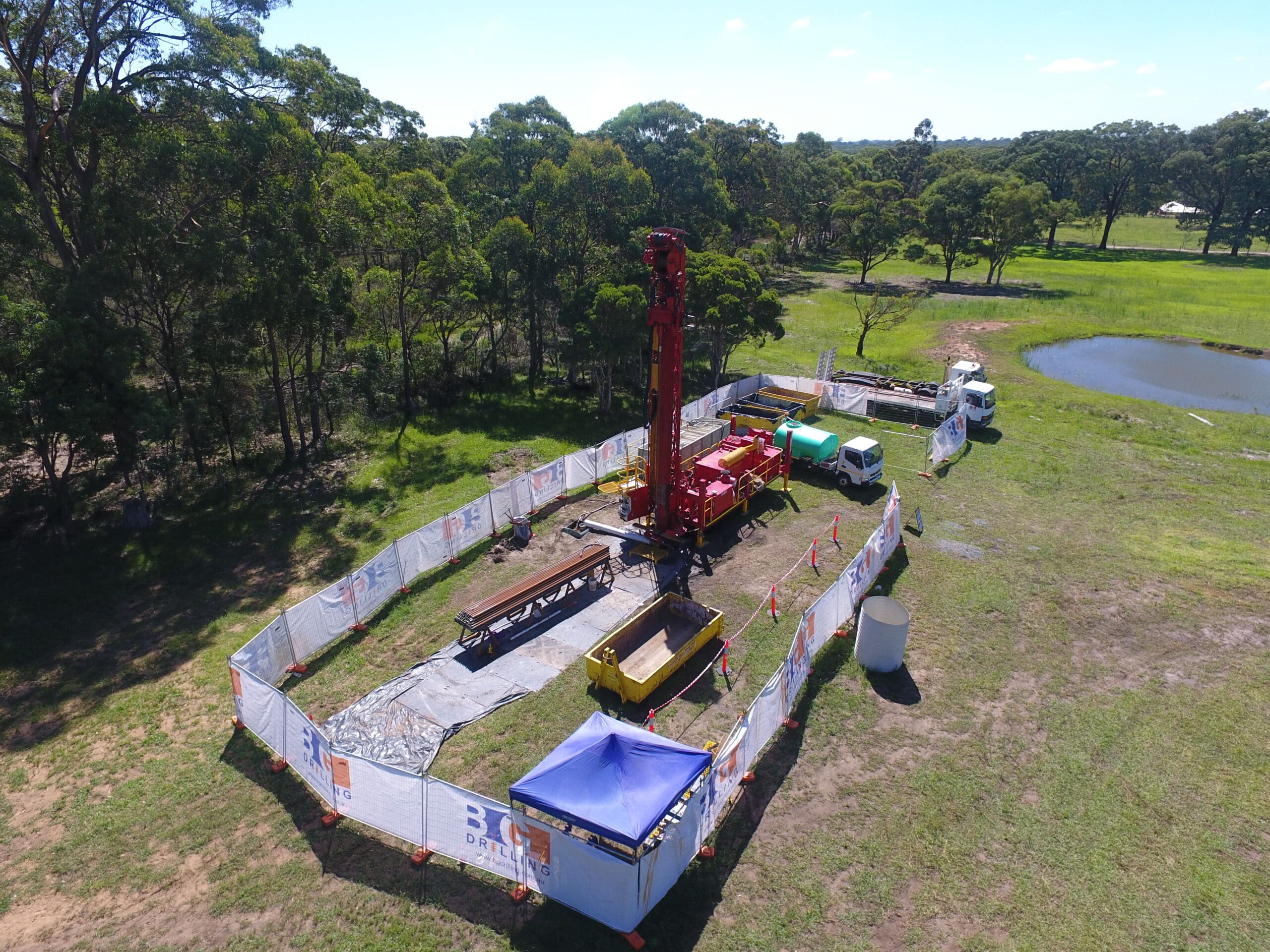
The geology also decides how the hole is drilled. Mud rotary suits soft ground, where the drilling fluid holds the hole open. Air drilling suits hard rock, and shows water as soon as the bore intersects it.
Does water divining work?
Some landholders still call a water diviner before they drill. We don’t site bores by divining. We site them on the geology and on the records of the bores around you, because that is evidence we can put in front of you and stand behind.
It is also why we can offer our guarantee. If we drill and don’t hit water, you are not charged. Most water bore drilling is billed per metre whether water is found or not, which leaves that risk with the landholder. We carry it instead.
How deep is bore water?
It depends entirely on where you are. Nearby bore records and aquifer mapping give an expected range for your site before drilling starts, and that range is part of what we give you at the site assessment.
Depth is not a limit on what we can do. Our rigs drill to 2,000 metres, although almost no water bore needs anything close to that.
Can a bore run out of water?
Every bore has a sustainable yield: the flow it can deliver without the water level dropping too far. Pump it harder than that and the water level is drawn down past the pump intake, the pump runs dry and it burns out.
That is why we test pump every bore we equip, under load, before the pump is chosen. Test pumping gives three numbers: the sustainable yield in litres per second, the standing water level, and the drawdown while the pump is running. The bore pump is then sized to what the bore can actually give.
The practical things that decide where the bore goes
Where the water is comes first, but the spot also has to work on the ground. Before we choose it, we check:
- Access for the drilling rig
- The distance to the tanks or the irrigation head
- Setbacks from septic systems and boundaries
- The run of the power supply to the pump
A bore drilled fifty metres from the right spot can cost you half the yield and years of pumping cost. You also need approval before the bore is built. The NSW Government’s domestic and stock rights FAQs say you need a water supply work approval to construct a groundwater bore, even for household and stock use. Our bore water licence NSW guide explains which approval applies to you, and we organise it through Water NSW.
Get a free site assessment
The quickest way to find out whether there is bore water on your property is a free site assessment. We look at the local geology, known aquifer depths in your area, existing bores nearby and their recorded yields, access for the rig and where the water needs to end up. You get a written quote, and if we drill and don’t hit water, there is no charge.
See how our water bore drilling process works from licence to pump, call 0408 915 449 or book a free site assessment.